249€ or 2 x 125€

LEARN KALMAN FILTERS: The Hidden Algorithm that Silently Powers the Future

Learn the #1 Most Important Skill in Robotics, State Estimation, Sensor Fusion, and Tracking.

Get your VIP Ticket to build Autonomous Robots, Farms, Devices, Drones, and Self-Driving Cars.

Would you present yourself at the gate of a plane without a ticket?

Or would you go to a concert without first owning a ticket?

Of course not; these kinds of events require you to have your ticket; and you would never try and go to a plane's gate asking if there is by any chance a free seat nobody paid for.

These "tickets" are everywhere in the tech world.

  • In Computer Vision, the "entry ticket" is called OpenCV. You can't go to a Computer Vision interview without first learning OpenCV.
  • In Web Development, this ticket is called HTML/CSS. And these days this is really half of a ticket.
  • In Deep Learning, this ticket is a library like PyTorch or Tensorflow.

Just like for the concert or the plane, you need these "tickets" to enter the market.

And without them, you shall not pass.

So what is the entry ticket for Robotics & Autonomous Tech?

It's called a Kalman Filter; and it's one of the most important, if not the most important algorithm you can learn in Robotics & AI.

In fact, it's so important that the prestigious MIT once said "Kalman Filters are to Robotics what the Pythagorean Theorem is to High Schoolers."

Just that.

But what is it?

Well, it's in the RADAR that gave you a speed ticket last month. It's in the bathroom scale you use everyday. It's in your phone, smartwatch, tablet, computer, and stylus pen. It's in autonomous vehicles, trading robots, space rockets, software, and even military weapons.

Chances are today, that if you're using an electronic or autonomous device, a Kalman Filter is implemented inside.

A few examples?
  • Your LiDAR sensor reports that it sees a pedestrian 12.8 meters ahead, but your Computer Vision system reports 11.9 m, and your RADAR says 13.4 m. This is a Sensor Fusion problem, and it's solved using a Kalman Filter.
  • Your object tracker reports a pedestrian running at 8 km/h, but then sees sudden changes in the position, affecting the speed to 7 and then 12 km/h. How do you know the exact speed? This is a tracking problem, and it's also solved using a Kalman Filter.

A Kalman Filter is the solution that is better than averaging (that causes too many errors), and it's also considering the strengths and weaknesses of each sensor.

In Robotics, Kalman Filters are a Swiss Knife you want to use every time you need to estimate the state of something (a speed, position, ...):


And this is why this algorithm is the Autonomous Robot Entry Ticket, it's because you need it all the time!

And as an aspiring Robotics Engineer, your #1 task is to understand it, master it, and be able to adapt it to any situation.

How I learned about Kalman Filters

A few years ago, I was working on an obstacle detection project that didn't go well. The sensors were noisy, sometimes even wrong, and for some reason, my algorithm didn't work 100% of the time.

When asking my colleague, I heard his tips: "Use a Common Filter!" (this is how much I knew)

I felt even worse when I saw the actual Kalman Filter definition, and when I dug in the papers.

Pages of Maths.


I love maths, but there are some things we should never see when learning about a topic for the first time. After just a few seconds, I was completely discouraged.

I tried blog posts, vulgarization articles, I even tried to include Kalman Filters code in my project without bothering to understand...   But nothing worked, and my project and skills didn't move one inch.

Yet, it was still very important for my career as a Self-Driving Car Engineer.
No matter how hard I tried, this algorithm was more secret than my grandma's lemon cake. Yet, it's everywhere!

The number of easy and clear explanations were so low, that I had to watch every single one of them to be able to say:

 "I think I got it, but I'm not sure."

It's only months later that I could be "sure", publish articles, code advanced projects, and validate that I have this skill.

I was relieved, but it cost me...

No matter how many posts you can read on the topic, learning Kalman Filters is difficult.

And I can tell you, you can go through all of them...

And still don't get a clue about how to use a Kalman Filter!

Especially when your problem is "different" than the examples.

You will get that face though.

So how to avoid the struggle?

I made a course that is easy to get, step by step, and where the equations don't change every two minutes...

But more importantly, I created your entry ticket to the Robotics World.
Whether you'd like to build SLAM systems on autonomous robots, to join the Sensor Fusion teams of Self-Driving Car companies, or to prototype your next healthcare startup, you'll need Kalman Filters, and you'll need to understand them really well...

Introducing...

LEARN KALMAN FILTERS: The Hidden Algorithm that Silently powers the future

And this course will be the simplest and most step by step explanation you can find on Kalman Filters.

MODULE 1

Introduction to Bayes Theory & Kalman Filters

Understand how Kalman Filters work, get the hardcore maths simplified, and build a deep understanding of Bayesian Algorithms.

What you'll learn:

  • How to get amazingly accurate predictions with noisy sensors using Bayesian Filtering
  • The 2 most popular ways to use Kalman Filters in an autonomous robot (and 4 examples of Kalman Filters in the industry)
  • What is a "filter" and why it's better than averaging multiple values
  • A "From Scratch" Example of a 1D Kalman Filter running to track a robot
  • Demystifying the Bayes Rule and the hardcore maths behind it
  • How to include probabilities in a robot tracking project, and how to predict past and future positions.
  • What are Gaussians and how to use them with LiDARs, RADARs, or other sensors
  • 2D/3D Kalman Filters — How to increase the dimension of a Kalman Filter, without making the maths too hard to follow?
  • An introduction to Multivariate Gaussians & 2D Tracking
  • The Harcore Maths of Kalman Filters, simply explained (doing this, we'll build a deep level of understanding useful to then apply a Kalman Filter in ANY PROJECT)
  • What to pay attention to when reading a paper that includes Kalman Filters (and why sometimes equations have different variable names)
  • What is the F matrix and how you can use it to model any object behaviour
  • The 3 types of Kalman Filters orders, and a common mistake most engineers make early on when designing a Kalman Filter

MODULE 2

Coding your first Kalman Filter

In this second part, we'll code linear Kalman Filters in 1D and 2D from scratch. This part will give you the necessary level of understanding to the design a Kalman Filter for any possible situation. 

What you'll learn:

  • Exactly how to fill your Kalman Filter matrices in a project
  • The difference between second order Kalman Filters and 2D Kalman Filters, and why these are totally different
  • A coded explanation of how to use Gaussians to represent sensor uncertainty; and what happens to these gaussians when you're tracking an object
  • What to put in the uncertainty matrices when you don't know the sensor precision, or the model uncertainty
  • BONUS: The Kalman Filter Cheatsheet - Use my PDF to design a Kalman Filter in just a few minutes without mistakes, every single time.
  • Coding 1D & 2D Kalman Filter from scratch
Once you've been through that part, you'll be ready for part 3.

MODULE 3

Bicycle Tracking Project

Take your skills to the next level and learn to track a bicycle using an object detection algorithm and a Kalman Filter you engineered from scratch.

What you'll learn:

  • How to robustify any failing object detection algorithm (algorithm do miss sometimes, and we'll learn to keep track of an object no matter if we detect it or not)
  • How to initialize matrices when tracking bounding boxes versus a 2D point (lots of engineers can't generalize the problem, and this is due to them learning by tutorials instead of getting a good understanding of the topic, we'll learn to generalize here)
  • Exactly when to use a Kalman Filter (and when not to)
  • The Kalman Filter implemented inside the Apollo XI mission to the moon
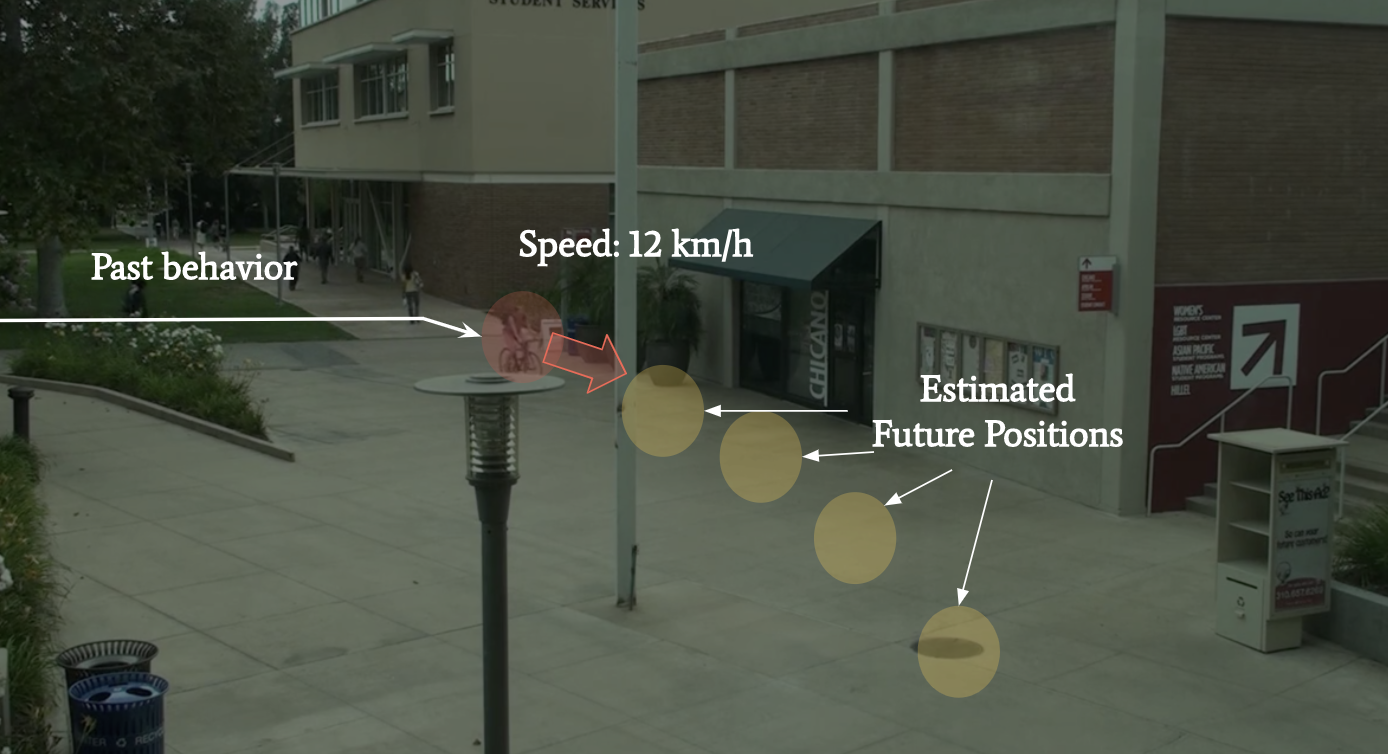
  • How to predict the future positions of an object, and correct your predictions "on the fly" if you're wrong
  • PROJECT: Build and Design a Bicycle tracking system
If we stop here, here is what you'll need to learn:


Not only will you be able to do this, but you'll also be able to do this based on very few detections (just one or two here and there, and you can design this system to predict the directions between measurements)

FAQs

What are the prerequisites to join?

We'll code in Python, and the maths will involve linear algebra and matrix multiplications. This is a course that is easy to enter, and that builds strong foundations to then learn more advanced skills like SLAM or Bayesian Deep Learning (becoming super popular lately).

How do I know whether I should learn Kalman Filters or not?

Although this course has a low entry barrier, I definitely wouldn't recommend it to anyone. Especially if you're not interested in Robotics, Sensor Fusion, or Tracking.

But if you see yourself working on these applications someday, then see this course as an entry ticket to the companies working there.

More importantly, this course is about dreaming.

Kalman Filters have been invented in the 1960s and were used in the localization system of the Apollo XI mission to the moon. This algorithm allowed a rocket to navigate to the moon, and land.

Many engineers have basic AI or Machine Learning skills, but are stuck in jobs doing Consulting, Data Science, Data Mining, or other tasks. Some engineers completely lose connection to their technical part and never get to code maths, implement complex solutions. At some point, it can become just about management and spreadsheets.

If you'd like to keep a connection to your 'technical you', and if you want to be designing complex solutions and physically work and touch real robots, then this course is for you.

How will the course help me get a job?

It will at least help you not get disqualified and eliminated on sight.

In many job offers, "Kalman Filter" is a requirement. It's not just a requirement like "It'll be great if you had prior experience in the field." It's something engineers build and use daily, and where there is a strong need to understand the foundations and advanced concepts.

Here is an example for a job as "Computer Vision & AI Engineer" at Tesla in the Autopilot team where you can see Kalman Filters in the requirements lists, even though the job is about 3D Computer Vision.

Note how this is important to be put in a job offer that has technically nothing to do with Kalman Filters. For Tesla and many companies, it's listed on every single page!

What is the duration of the course?

In general, I try to make my courses as short as possible, while giving access to a lot of detail.

As I explained, Kalman Filters are a very hard topic, and without a guide, it could take you months to understand these and be able to use a filter anywhere you'd like.

Which is why I'm taking the entire part I and II to explain the maths with a step by step approach, and to help you code one from scratch.

Depending on your existing skills, and really, if you're focus and have music on when learning about the maths, it can take you anywhere between 7 and 15 hours to complete the course, and to list it on your resume.

Testimonials?

"I enjoyed the course and found the information interesting and useful. I appreciated the approach of maths, walkthrough, project. Overall, I am very satisfied and will consider other courses."

Clifford Wahl, Software Engineer

"Kalman Filters are something I've wanted to learn for a long time as these are not usually taught on AI courses, but more with Robotics. 

At the start the maths looked terrifying but by the start of the assignment Jeremy had broken it down into a very understandable and non-terrifying mass of letters and numbers that suddenly made sense.  

I now look forward to improving my computer vision models with Kalman Filters and seeing how far I can take them."

Dan Harvey, Software Engineer

"I really enjoyed the course, the curriculum is flawless."

"It helped me connect many dots together related to probabilistic robotics.
 
This coursework is really amazing and it has given me some insights about those topics I was really not aware at at the beginning."

Mayur Waghchoure, AD Software Engineer

"I've done many Kalman courses in the past but the example with the bicycle really opened my eyes"

"This is a great course and it is exactly what I was looking for! To be honest I played with the code quite a few hours and could develop a really good understanding how a Kalman filter works. Thanks a lot and I hope you'll come up with another course on Particle Filters."

Ivo Germann, Development R&D Engineer for Vision Systems

Mathias Mantelli, Software Developer in Robotics

"If you have heard that KF is too difficult to learn because there is a lot of probabilistic associated with it, do not fear."

The Kalman Filter course starts from the basic probabilistic concepts and it goes until a practical example applying the taught algorithms.

You're going to learn everything that you need. Besides, Jeremy is very thoughtful to the ones who are taking the course and replies to every comment you make."

249€ or 2 x 125€

LEARN KALMAN FILTERS: The Hidden Algorithm that Silently Powers the Future

Lifetime access to:

  • Understand Kalman Filters at the deepest level

  • Implement your first Kalman Filter from scratch

  • Build an advanced Kalman Filters project to track a bicycle

Plus:

  • The Kalman Filter Cheatsheet: Design Kalman Filters in minutes without mistakes, ever single time.