• €249 or 2 monthly payments of €124.50

SLAM v1

  • Closed

Start your journey in Localization, Understand SLAM, and Improve your skills in Autonomous Robotics.

📨 This course is now closed and will open in the week of April 8, 2024. Join the SLAM Waitlist to be notified and receive SLAM goodies.
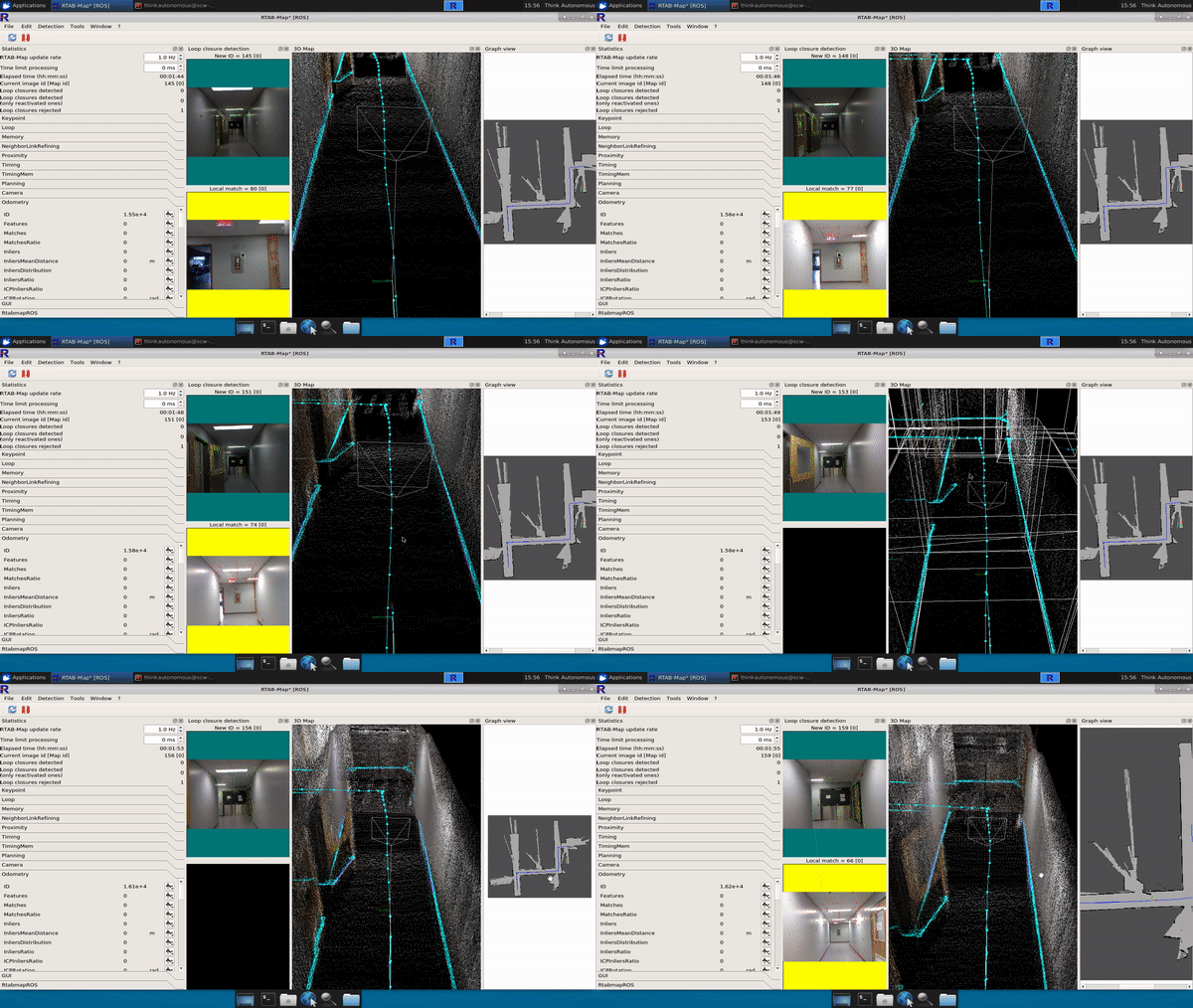
A Robotics Engineer must understand the entire process. SLAM is one of its pillars.

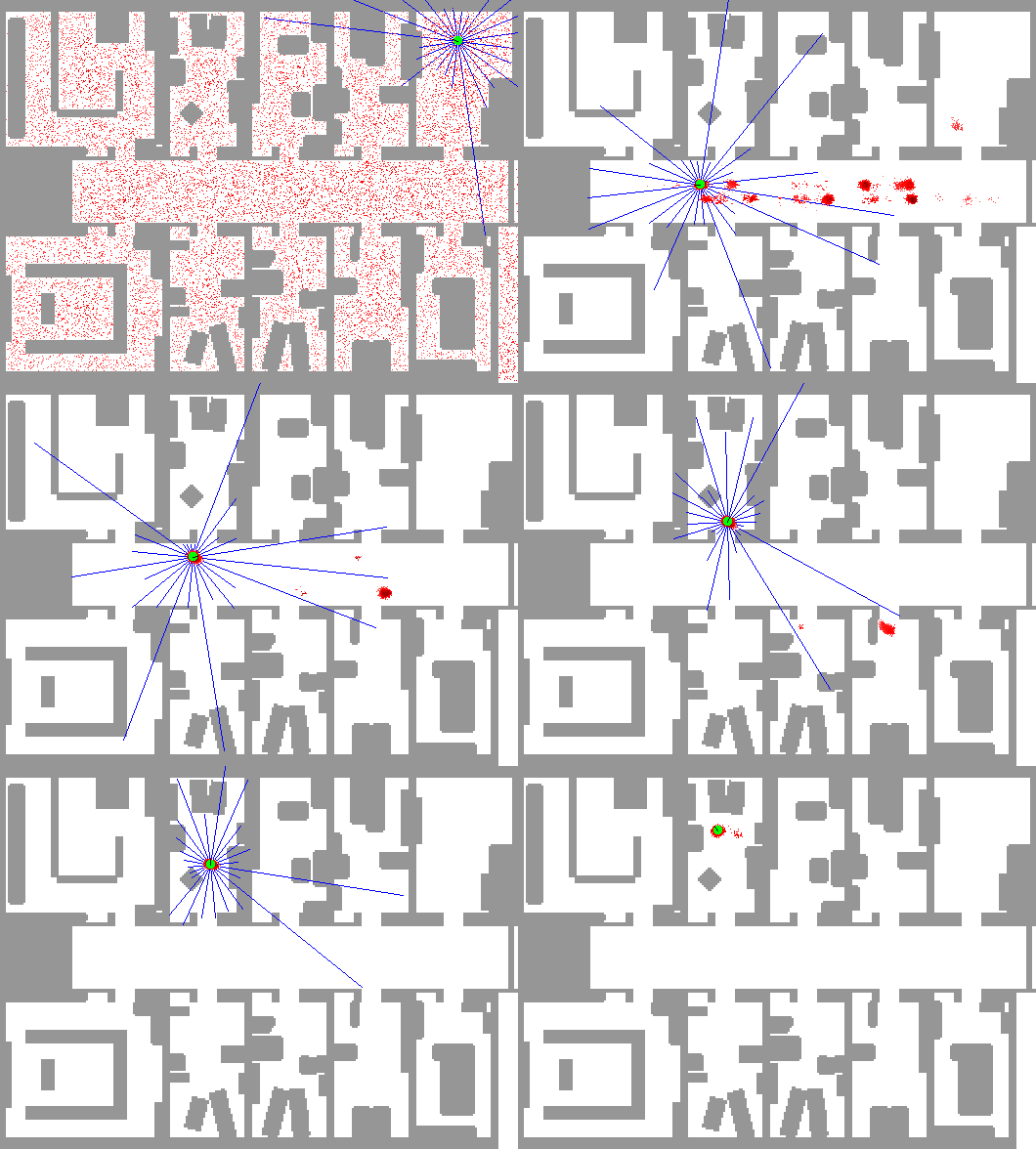
Localization is the process of finding your robot's position in the world... generally, we use a map and want to position the robot in this map.

But there are many cases where it's not do-able:
  • In an indoor environment, when the map changes all the time.
  • When the GPS signal is bad or inexistant (tunnel, clouds, ...)
  • Or simply when we don't have a map.

These use cases started by being a few exceptions... but today, they're the rule.
And this is why engineers use a technology called SLAM.
Because it allows to build a map and localize at the same time.

Companies that bet on SLAM

There is no Introduction to SLAM for beginners.👎🏼

99% of the content out there is made of research papers.
👉 There is almost nothing for localization beginners.

In fact, I have tried many times to learn about SLAM and couldn't do it, because of the lack of information.
I stopped on words hard to get...
'Fast SLAM': it's probably a faster algorithm? right?

Well, not really.

For any engineer aspiring to work on Self-Driving Cars, SLAM is the solution, and the problem.

Introducing... THE GRAND SLAM! The best introduction to go from 0 to 1 in Simultaneous Localization And Mapping.

(And quite honestly, the most easier to understand SLAM course on Earth)

1 — Introduction to Localization

Learn the Fundamentals of Robot Localization and SLAM. What are potential SLAM use cases? How to localize with or without a map?


  • PROBABILISTIC ROBOTICS: The main tools of localization engineers and how they work
  • How to BUILD A MAP using the output of PERCEPTION
  • THE 3 ALGORITHMS at the heart of any localization or SLAM project
  • ✔️ USE CASES and APPLICATIONS of SLAM in the real world
  • 3 WAYS to classify SLAM algorithms into MAIN FAMILIES
  • The MATHS behind SLAM
Concepts: Probabilistic Robotics, Gaussian Filters, Kalman Filters, Particle Filters, Information Filters, Online SLAM and Full SLAM, Direct and Feature Based SLAM, ...

2 — SLAM Deep Dive

Learn about the 3 Main types of SLAM Algorithms and convert measurements into a map.

  • The principles behind DATA ASSOCIATION and GRAPH OPTIMIZATION
  • How to consider NOISE in your algorithms
  • CHALLENGES: Convert a Perception Output to a SLAM problem and solve it!
  • How LOOP CLOSURE works, with or without COMPUTER VISION
  • THE THEORY behind EKF SLAM and most important things to know about it
  • FAST SLAM - How to use Particle Filters with SLAM?
Concepts: Extended Kalman Filters, Fast SLAM 1.0, Fast SLAM 2.0, Graph SLAM, Maximum Likelihood Estimation, Data Association, Loop Closure, ICP, Graph Optimization, ...

3 — SLAM Simulation


Learn to use build maps using SLAM with ROS Platforms. Create your own environment, navigate in the it, and map the world while you're doing it.

Some of the things covered:
  • Introduction to ROS: The PLATFORM to build self-driving cars
  • SLAM on the CLOUD and on a RASPBERRY PI.
  • The MAIN ALGORITHMS available in ROS and how they work
  • How to launch a ROBOT SIMULATOR and MAP A WORLD
  • VISUAL SLAM ALGORITHMS and how they work
  • 🔽 (Bonus) YOUR SLAM MINDMAP as a PDF
Concepts: Gazebo, RViz, GMapping, Hector SLAM, RTAB MAP, Visual SLAM, Rosbags, 3D Mapping...

FAQs

Can this course get me a job in SLAM?

🚀 This course will be your guide to learn about SLAM, and go from 0 to 1.
Once you've completed this course...
  •  You'll have cleared your mind with the SLAM mess.
  • You'll be able to label most algorithms, and to know how they work. 
  • You'll have run several SLAM algorithms on simulators, and you'll know about advanced SLAM algorithms.
👉 If you apply for companies that require a good SLAM understanding and the ability to run popular algorithms, then this course has been made for you.
👉 If you apply for companies that require you to code your own SLAM algorithm, then this course will not cover it, but will be a good introduction.

What are the prerequisites to follow the course?

You can reach "1" in just a few hours, if you validate the following prerequisites:
  • Maths - Matrix Multiplications, Linear Algrebra, Calculus, and Probabilities
  • You already handle Linux Command Lines
  • This course's project is made with a Spreadsheet, to demonstrate the simplicity of an algorithm. For that reason, being a good coder is not necessary.
  • If you understand Kalman Filters, it's a big plus.
  • If you understand and handle ROS, it's a big plus.

Is it a Computer Vision course?

SLAM works with Computer Vision, and this course introduces the idea.
In the ROS part, you'll get to play with a Computer Vision algorithm running on SLAM.

The topics you'll learn are more about "Probabilistic Robotics" than Computer Vision. 
👉You'll dive into Kalman Filters, Particle Filters, and Information Filters and their applications in the SLAM field.

Are there projects? Assignments? Coding?

Almost all of my courses have coding assignments.
This one doesn't.

When you begin with SLAM, coding is secondary.
What really matters is your ability to well understand the fundamentals and be able to run the most common functions.
👉 For that, the first thing is to focus more on the algorithms themselves and on how to tweak them than on the code.

Once you'll understand that, you'll be able to start more challenging projects and begin coding!

👉 To maximize understanding, the course has assignments made on an Excel Spreadsheet with optimized formulas for SLAM. 
👉 Then, the course helps you run SLAM on ROS, which is the MAIN WAY to run SLAM algorithms and make self-driving cars work.

"I really got a good feeling of how SLAM works"

The course showed me all the way to perform a solid simulation and to play with it until I really got a good feeling how SLAM works. The course certainly is not long enough to answer all my theoretical questions but it gave me the links to investigate deeper on my own.

In the end I was able to implement SLAM on my own robot with ROS. And together with the ROS course I not only got it working but started to understand what is behind it.

Ivo Germann, Development engineer R&D, Project leader bei Zumbach AG

  • €249 or 2 monthly payments of €124.50

SLAM v1

  • Closed

Master Simultaneous Localization And Mapping for autonomous robots.

Lifetime Access to:
  • Introduction to Localization
  • Understand SLAM with a Deep Dive
  • Build SLAM projects with ROS Simulators
Plus:
  • The SLAM MindMap

📨 This course is now closed and will open in October 2023. Join the SLAM Waitlist to be notified and receive SLAM goodies.