* This course is an add-on to the HydraNet course and cannot be purchased independently. Make sure you go through the HydraNet course first to get access.
Embark in this final HydraNet adventure, and learn to build...
Dear HydraNet Engineer, if you'd like to learn how to take your Deep Learning skills to stratospheric proportions, then this page will show you how...
Back when I released my HydraNet course — that taught engineers how to do joint depth estimation and semantic segmentation, it's been an instant hit. The course was critically acclaimed! Loved by the Engineers! It was not only a fantastic way to stand out, but it was also genuinely good Deep Learning skills that the engineers were learning.
But something has been requested over and over again...
And who could blame the engineers for wanting to learn MORE? And to go FURTHER?
I get it.
If you have a HydraNet that can only do depth estimation and semantic segmentation, every new model is an additional model:
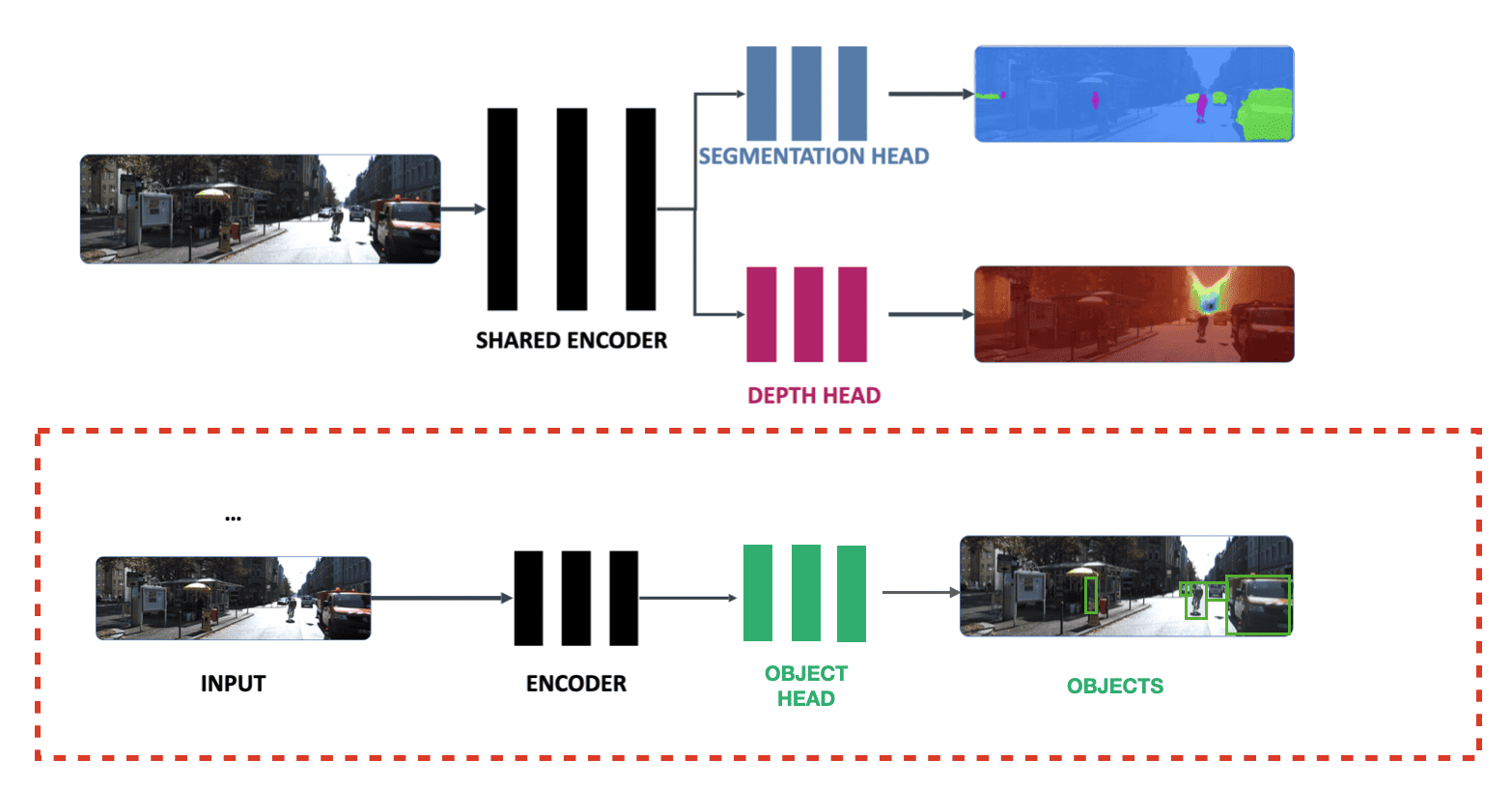
You know what this means, if you can't add the Object Detection Head to the model, you didn't really succeed. I have no doubt that after the HydraNet course, your skills allow you to add new Heads to the model, but Object Detection is a unique kind of head. It's not just a head, it's multiple heads, at multiple scales, using anchors, grids, and it's far from depth estimation or semantic segmentation.
But if you can do that, then you can do almost anything, because going from 1 to 2 can be luck, but going from 2 to 3 is skill.
And this is what this DLC is going to teach you...
This is how models are coded in the world; they aren't always entire object detection models, they are often just heads plugged to existing architectures, that enable the rest of networks to work!
Take, for example, Tesla's HydraNet, and notice how the object detection head is just plugged here in the middle of a larger network, which is itself part of a larger End-To-End network.
And these heads are very common practice in Deep Learning.
They're used in 3D Object Detection on Point Clouds — which are often converted to 2D, and processed with 2D Object Detection Heads — and they're also used on top of Bird Eye View Features, in Deep Sensor Fusion algorithms.
In most research projects involving Perception, you'll see an Object Detection Head here and there. This actually a common but well-guarded skill among researchers.
As I said, it's definitely not a trivial task. There are MANY options, anchor-based, anchor-free, two-stage, one-stage, doing bounding box regression, doing centerness prediction... It's not simple.
Following my HydraNet Engiener's requests, I wanted to do a DLC about Object Detection, but I wanted it to be the EXACT CONTINUITY of the HydraNet course.
No trick. We pick the exact same model, and we continue where we left off after the course — this way, we're not accidentally building an object detector, we're building real skills.
But there was a problem — To teach object detection, you have to teach multiple detectors. One example just isn't enough, because each algorithm uses many techniques, and you need to see many to "get it".
So how could I have a DLC featuring many algorithms, all heads of the original hydranet?
In this challenge, the HydraNet Engineers would be given the foundations to build an Object Detection Head, and would then compete to build their own...
This way, we would have dozens of engineers building object detection heads, the best of them would be featured in the course for you to learn, and ONE of them would win a prize...
These 3 submissions built the base of our HydraNet Object Detection DLC:
An Anchor-Based model combining multi-scale detection and Bounding Box regression. In this architecture from Jing-Yi Lim, you are learning about the fastest one-stage object detector.
An Anchor-Free Model combining De-Coupled Heads from YOLOX and Centerness Prediction from FCOS. This algorithm built by Edgeneer Isaac Berrios is a mini-hydranet working at 3 different scales.
The State-Of-The Art of Object Detection — plugged to the HydraNet. In this project, you'll learn how Dheeraj Madda won the HydraNet challenge using YOLOv8! 🏆
Notice how these heads are extensions of the Hydranet from the course? And notice how we have several different approaches?
This is what I'm talking about!
And if you want to learn how to build these extremely advanced architectures, and build mastery in Deep Learning and HydraNets, then it's time for us to tell you about...
In this advanced module, we'll start from our existing HydraNet, and add a new Head on top of it to detect objects in 2D. In this course, you will implement Object Detection Heads layer by layer, and understand most of the object detection types out there.
This DLC is in two parts.
In this first part, you'll are being given the foundations to build your own object detector from the existing HydraNet. You will learn about one stage object detectors, anchor boxes, and more...
Specifically, you will learn:
The ONE THING that every object detection head possess (without it, it wouldn't work — it's not bounding box regression, it's not anchors, and it's not even labels)
Anchor Based vs Anchor Free Networks: The well-guarded secrets of anchor boxes, and why researchers are moving towards anchor-free networks in 2024
How to extend an already trained HydraNet to accept an object detection head (there are specific preparation steps you need to run if you want to extend it, you can't just add a head)
How to build a "Lane Line Detection Head" — and what to do if you have several lanes to detect (we'll see how returning several heads is no different than returning several bounding boxes, and we'll analyze heads returning objects and lane lines)
A Deep Dive into a 2022 Pyramidal HydraNet Architecture capable of detecting objects, lane lines, drivable area froma monocular image (we'll look at the architecture, but also dive into he code, and you'll try to build intuition on the type of heads it can have)
The little known secret of 2D Object Detectors on 3D Point Clouds, and why 2D Object Detection heads are favoured in LiDAR Object Detection
How to train only a head of a network, and why freezing your weigths might still degrade your other heads (hint: it has to do with weight sharing in HydraNets...)
and many more...
At the end of this module, you should have KNOWLEDGE about Object Detection. We are not in the SKILL part yet — but you are going to have your intuition triggered, and your understanding of object detection will be developed.
We'll explore existing HydraNets and try to understand how they built their own Object Detection Head.
We'll dive into the idea of anchor boxes and try to understand the differences between anchor-based and anchor free models.
How do you get started? We prepared a starter code for you, with a step-by-step guide to build your own HydraNet!
In Part II, we'll dive into the Top 3 Architectures submitted in the HydraNet Object Detection Challenge. You will NOT learn how to implement a YOLO algorithm, or how to implement ONE object detector, but you will see, code, and test SEVERAL DIFFERENT ARCHITECTURES for object detections. You will get to run and code the approaches submitted in the challenge, and build expert skills in Deep Learning and object detection.
What you'll learn:
IMPLEMENTATION 1: YOLOX & FCOS — The secrets of mixing YOLOX and FCOS, two cutting-edge object detectors; and a VIP access to two notebooks on YOLOx & FCOS for HydraNet Object Detection.
How to build a "HydraNet Inception", and implement a HydraNet inside the Hydranet; and why it can be the best research technique to detect small objects.
Why Centerness prediction can be better than Bounding Box Regression, and how to use Anchor-Free Object Detectors.
Which loss function should you use for Object Detection, and how to parameter the weights of a multi-head object detector
IMPLEMENTATION 2: SSD — A deep dive into a HydraNet using Anchor Boxes and SSD (Single Shot Detector), and an access to an edgeneer's writeup and Notebook on SSD for HydraNets
How to deal with class imbalance, and dataset imbalance in HydraNets and Deep Learning
IMPLEMENTATION 3: YOLOV8 — How to architect, build, and code the State Of the Art of Object Detection, and the winner's 7 Notebooks and detailed 15 page analysis of YOLOv8 in HydraNets
A step-by-step example of Anchor Boxes and Grid Generations at multi-scales
In all cases, you also get:
The submission of the 3 finalists, splitted into 10 Notebooks, 3 detailed write up PDFs, PLUS my personal reviews explaining each submission in depth.
We made the Top 3 submissions completely accessible to engineers in the HydraNet Object Detection DLC. Something you should know is that there were strict requirements of these submissions: they had to be done on Notebooks, explained, and PLUG & PLAY. This means you now have several models you can run out of the box.
Not only you will get the Edgeneer's explanations, code, comments and writeups — but you will also get, for each submission, a video and chapter with me explaining the critical components of the code... so no part is ever obscure!
This course is specialized on HydraNets. We start where the HydraNet course ends. This is a pure DLC on how to add an object detection Head to an existing pretrained model. And it can be ANY model. This means that you won't just accidentally learn about some object detectors, you will learn to build serious Deep Learning skills.
JS (anonymized for company reasons)
"It was hard to believe that one could learn such advanced techniques through online courses alone, given the need for a working environment and suitable deep learning models.
The part I like the most is that all the materials related to the course can be accessed directly from the attached download link, and immediate execution and results could be checked through Google Colab. The entire process was seamless without any interruptions.
I also loved the fact that the course can always be revisited online, that online Q&A is supported, and that the educational content is occasionally updated.
I would recommend this course, it not only teaches academic theory or professional engineering skills but also provides practical training on how to navigate and reach the destination in the real field."
The HydraNet course has prerequisites that you can read. This DLC is the advanced version, and it requires you to take the HydraNet course first. We refuse entries to people who are not in the course — this is a sidequest for people in the Hydranet course looking for Deep Learning expertise only.
Why? Because yes — it's very advanced. We are at the cutting-edge of the cutting-edge; and there's no way I let beginners join, and then realize it's too advanced, and therefore waste the potential they have in this field by being discouraged.
If you are already in the HydraNet course, the level of difficulty will be much more manageable, in fact, it can even feel effortless for you to understand how to build object detection heads after this course.
The original HydraNet Object Detection challenge is no longer active. However, students of this DLC have the possibility to build their own HydraNet and submit it to Think Autonomous. Although the prize is no longer available, you can still submit your project and get featured in the DLC!
This course is not about Object Detection, it's about Object Detection Heads. In a traditional object detection course, you are learning about object detection architectures, and you may run some, but you don't really learn about the head; you are still stuck with 3 models for 3 tasks.
In this DLC, we are learning how to add object detection heads to existing networks.
This means, you can load several weight files to a single network — and you can take your trained head, and plug it anywhere you like, for example on top of other trained models. This is very powerful.
Look around. How many Deep Learning Engineers around you know how to do this? How many know how to add a depth, segmentation, or object head to an existing network? How many have the understanding to add any head to a network?
This may or may not be an immediate need for the company you're working for — but this is advanced Deep Learning practice skills. This gets shown, this is visible. You could be showing this portfolio project to a recruiter, a colleague, and get a job in Deep Learning, Computer Vision, or Self-Driving Cars.
I am confident that students of this course could very easily pass the message that they are the Deep Learning expert people should talk to.
* This course is an add-on to the HydraNet course and cannot be purchased independently. Make sure you go through the HydraNet course first to get access.