299€ or 2x 149€

LEARN HYDRANETS: Monstrous Multi-Task Learning Techniques with PyTorch

Learn Multi-Task Learning and build State-of-The-Art 3D Segmentation architectures with PyTorch
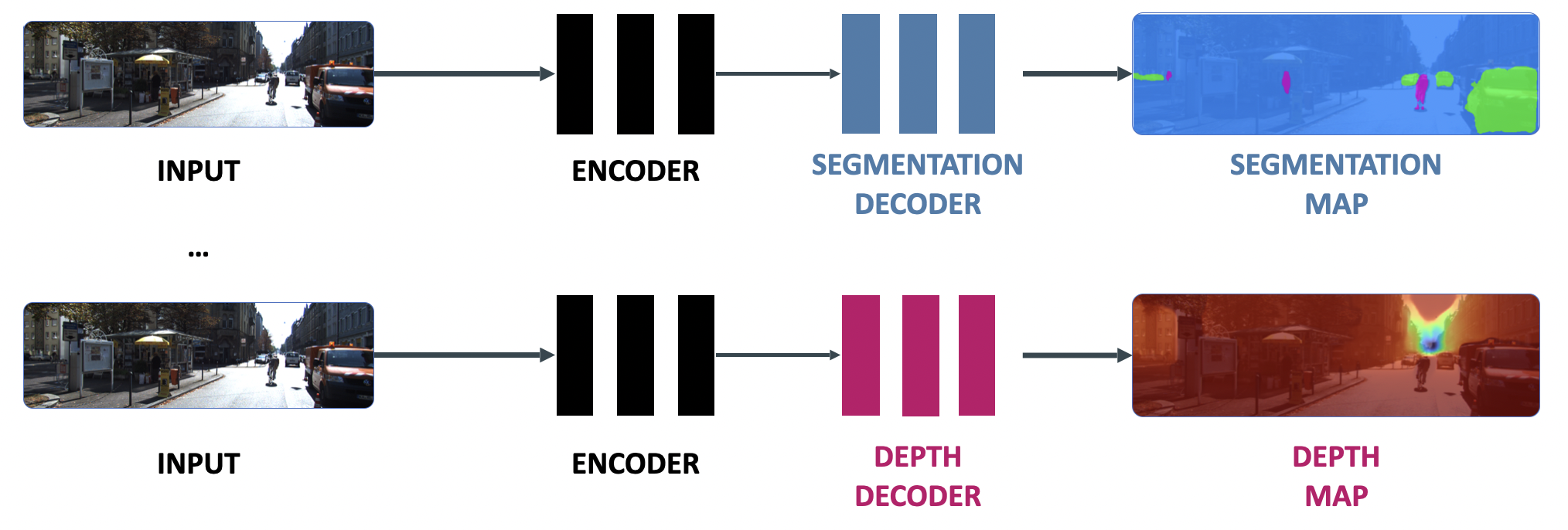
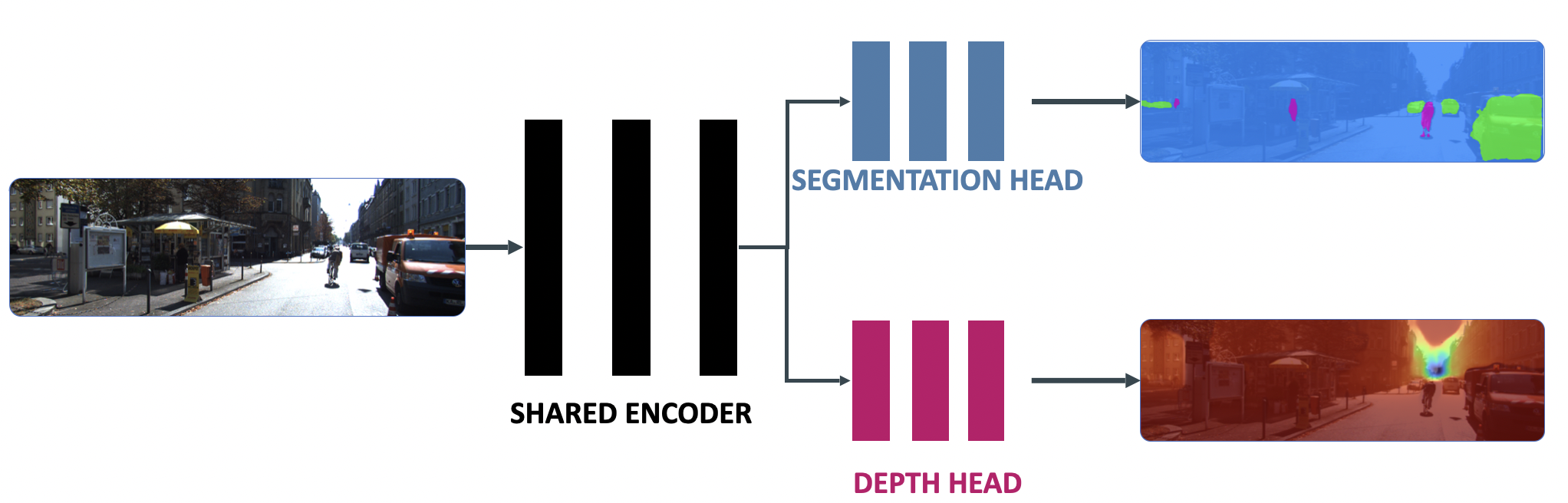
Take the following 2 models, doing semantic segmentation and monocular depth estimation, what do you notice?


If you look inside the black “encoder” part, that is responsible to learn features, you’ll see that the 2 encoders are the same algorithm. Yet, we still have 2 of them.
It means:
  • Twice the Memory Needed
  • Twice the Training Time
  • Twice the Coding Time
  • Twice the Inference Time
  • Twice the parameters
Than if we were just using ONE MULTI-TASK NEURAL NETWORK. Like here:
Then, we’d have a faster, lighter and more compact model. We wouldn’t unnecessarily repeat some operations, and if we’re lucky, we could even benefit from the fact that learning 2 tasks can benefit each other. Just when you’re learning to play tennis, and then you can suddenly play ping pong pretty decently.

👉🏼 I just showed you two algorithms that run in parallel... but take the case of a self-driving car: How many algorithms are needed? 5? 10? 20? 50?

Although Deep Learning has become the GO-TO in Self-Driving Cars & Computer Vision, it still has one flaw: most models are Single-Tasks.

Recently, I discovered that TONS of companies were secretly replacing all of their algorithms, that got stack to each other during the years, by ONE ULTIMATE ALGORITHM, also called...

A Multi-Task Learning Algorithm!

After reading code, papers, and studying companies plans, I realized that while most of the engineers are focused on single-task learning algorithms, many Deep Learning Startups have already shifted to using Multi-Task Learning.
  • It started a few years ago, when Tesla released their HYDRANET, an algorithm capable of synchronizing their 8 cameras, fuse them in time, and solve multiple problems such as object detection, semantic segmentation, depth estimation, and many more.. 
  • In late 2021, Google released their PATHWAYS, a "single algorithm capable of generalizing to millions of tasks".
This trend will continue over the years, as multi-task learning proved to be a more efficient and scalable solution. You'll even discover than in some cases, learning two tasks at once can make your results better than if you were just learning one task.

What if you were a HydraNet Monster?

A Quick Way to Stand out on your resume? List "Multi-Task Learning" inside. It's a skill that almost no other Deep Learning Engineer has. It's not common, but it's valued by companies. Learning it will also make your overall understanding of Deep Learning better.

👉🏼 What if you could be a precursor of that new trend, and be one of the only engineers who can work on multi-headed neural networks?  What if you knew how to "Cut One Head, and Two Shall Take Its Place"?

👉🏼 What if you could learn PyTorch from scratch again, but by building cutting-edge algorithms and by implementing advanced research papers?

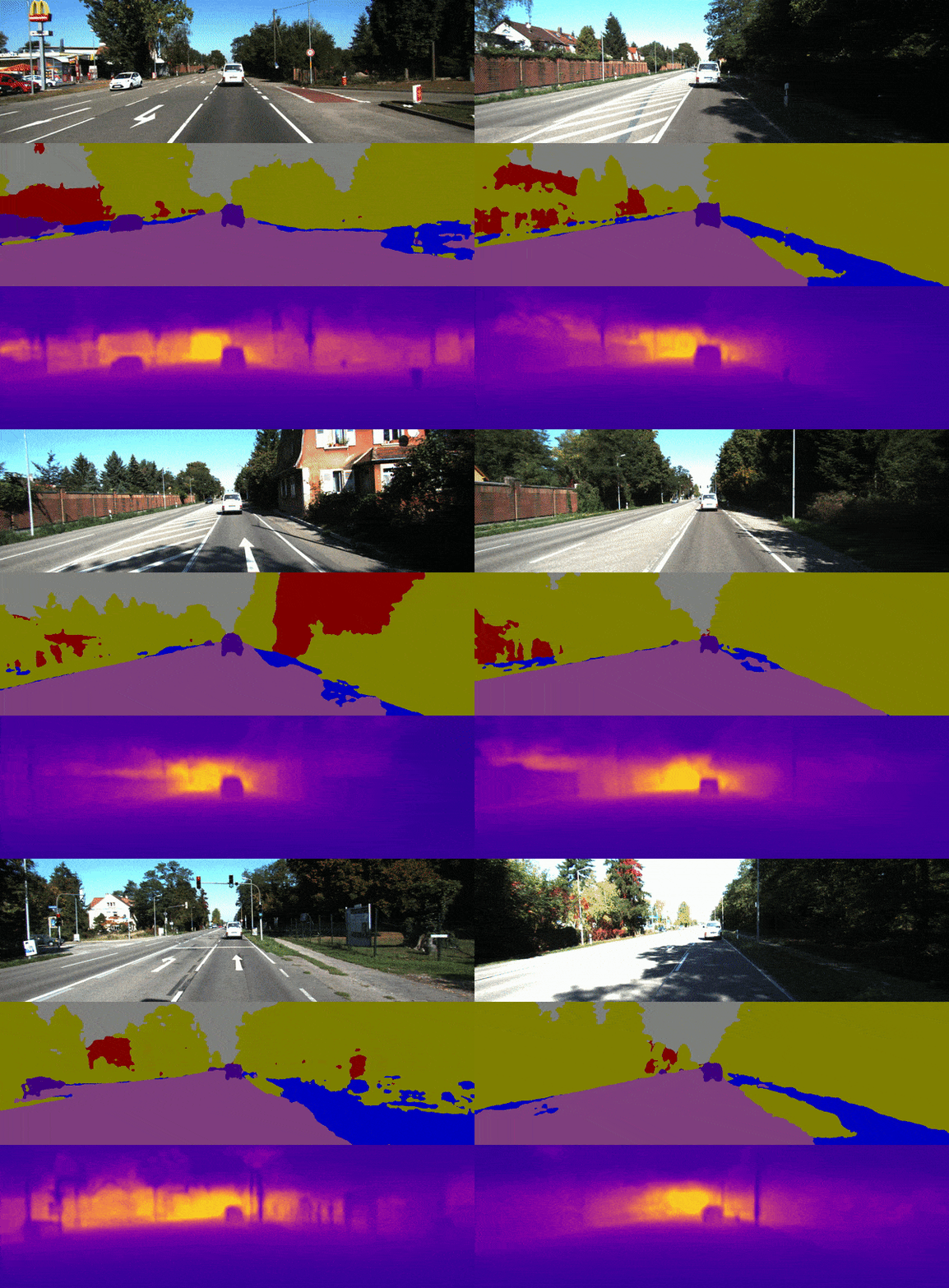
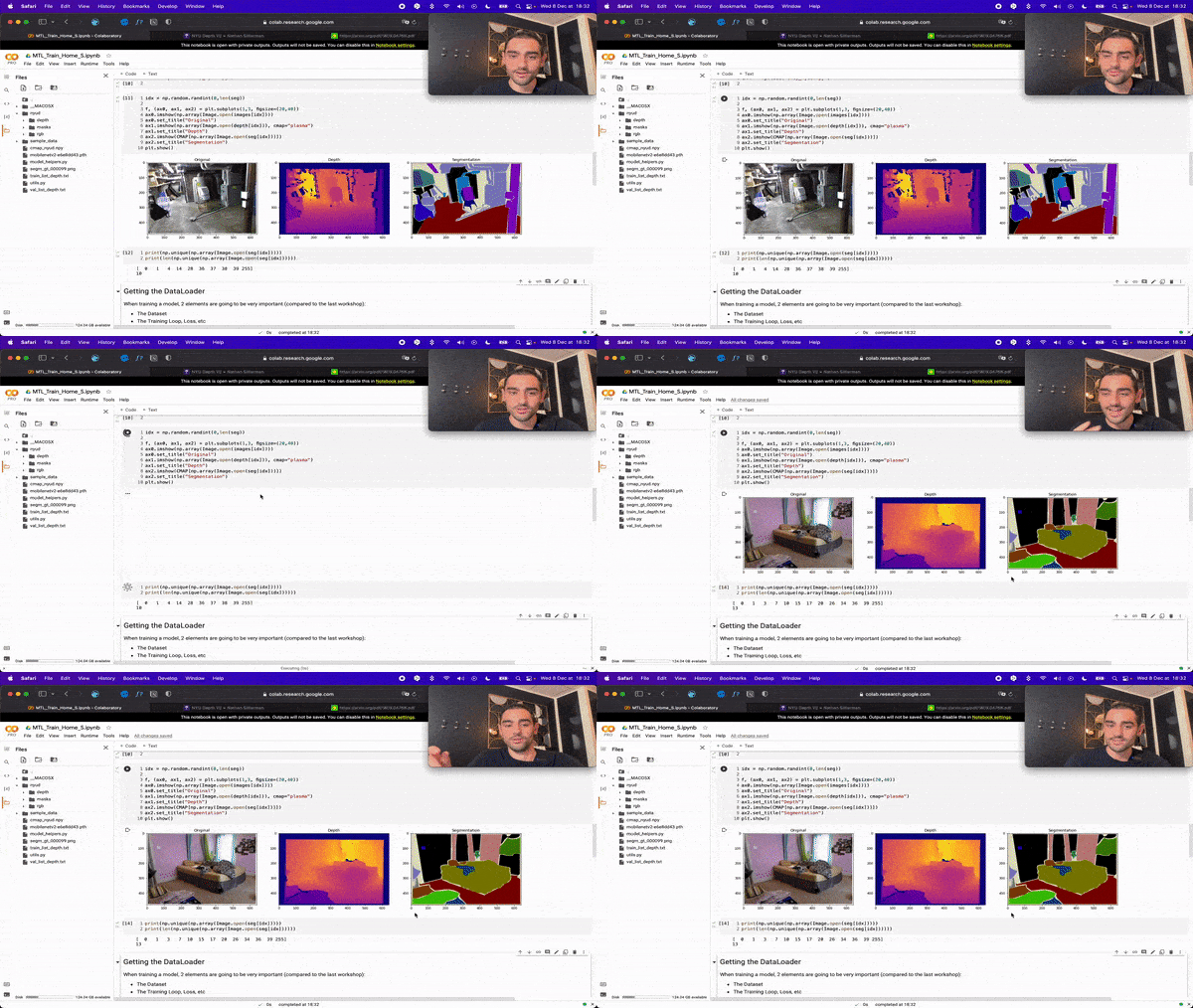
👉🏼 What if you could learn to build an algorithm that outputs a Depth Map and A Segmentation Map in REAL TIME?
Like this one:


Introducing...

LEARN HYDRANETS: Monstrous Multi-Task Learning Techniques with PyTorch

This course has been created for Deep Learning Engineers already aware of Neural Networks, but who don't feel comfortable with PyTorch, or the Practical Side of Neural Networks. The course will include a lot of practice, and will push your skills to the state of the art of Multi-Task Learning

If you're ready for an adventure in the Hydra World, here's the program:

Module 1 — Introduction to Multi-Task Learning with PyTorch

In the first module, we'll get familiar with the Multi-Task Learning algorithms implemented inside companies like Tesla, and we'll study the main rules and barriers in Multi-Task Learning.

You'll learn:
  • How to Build Advanced Multi-Task Models with PyTorch (even if you're a complete beginner) 

  • 2 Beheading Techniques to add heads to any pretrained Neural Network

  • How to build a Loss Function that can be optimized for 2 completely different problems, such as classification and regression.

  • How to tune your hyperparameters when heads are learning at different rates

  • PyTorch 101 — My cook-book to build a DataLoder, Create Models, and Train Parameters from scratch with PyTorch.

  • Inside Tesla's HydraNets — A look at Tesla's Multi-Task Algorithms and how they work to make it scalable at several hundreds of thousands of cars

  • 10 Advanced Deep Multi-Task Architectures to force communication inside a Neural Network— We'll go over Cross-Stitch Units, Bayesian Neural Networks, and many other ideas...

  • Multi-Task Learning in Computer Vision — Deep Dive inside an untold Experimentation that reveals which task you should train together... and avoid mixing!

  • The Intermediate Python Concepts you should know to make your code look more professional

  • PROJECT: Build your first multi-task learning algorithm from scratch with PyTorch to process images and do binary classification, regression, and multi-class classification.

After this part, you'll be more comfortable with PyTorch, and you'll know how to build multi-head models. You'll also know more about the multi-task models used by companies in the world. And you'll be ready to move on to module 2:

Module 2 — Advanced Multi-Task Learning for Self-Driving Cars

In the second module, we'll consolidate our PyTorch skills and implement an advanced research paper capable of doing Semantic Segmentation and Monocular Depth Estimation in Real-Time.

You'll learn:
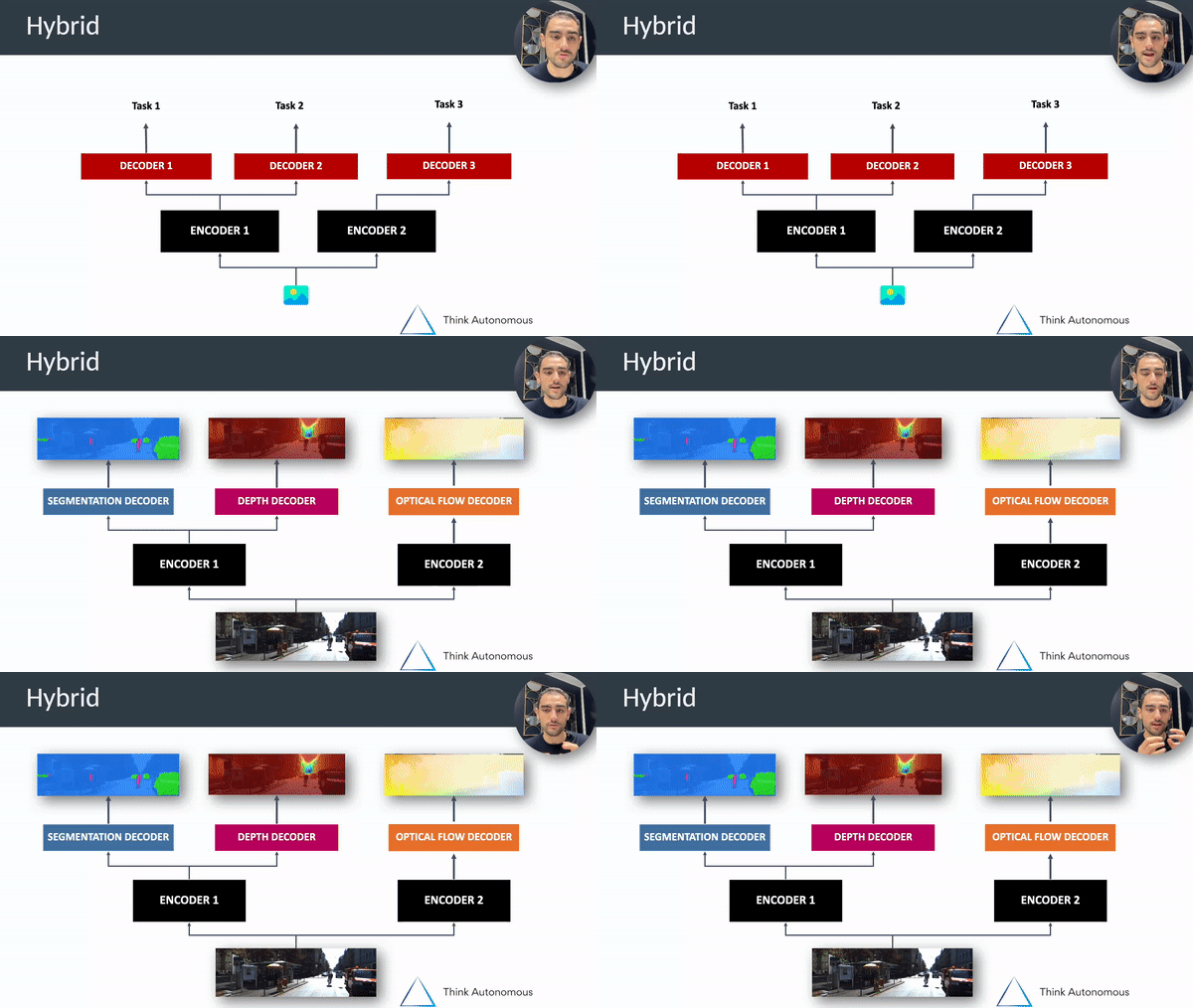
  • The Encoder-Decoder Architectures used to build multi-heads decoders that work better and faster than single task networks

  • MobileNet v2 from scratch — Build an mobile optimized encoder using Inverted Residual Blocks, Linear Bottlenecks, and ReLU6 Operations 

  • Separable Convolutions and the future of Convolutional Neural Networks

  • Ultra Fast Multi-Head Decoders for Monocular Depth Estimation and Semantic Segmentation (we'll go over CRP Blocks, CRU Blocks, and many other advanced Deep Learning techniques used in the field)

  • HYDRANET PROJECT — Build a HydraNet trained with 2 to 3 heads that does real-time semantic segmentation and depth estimation in self-driving cars.

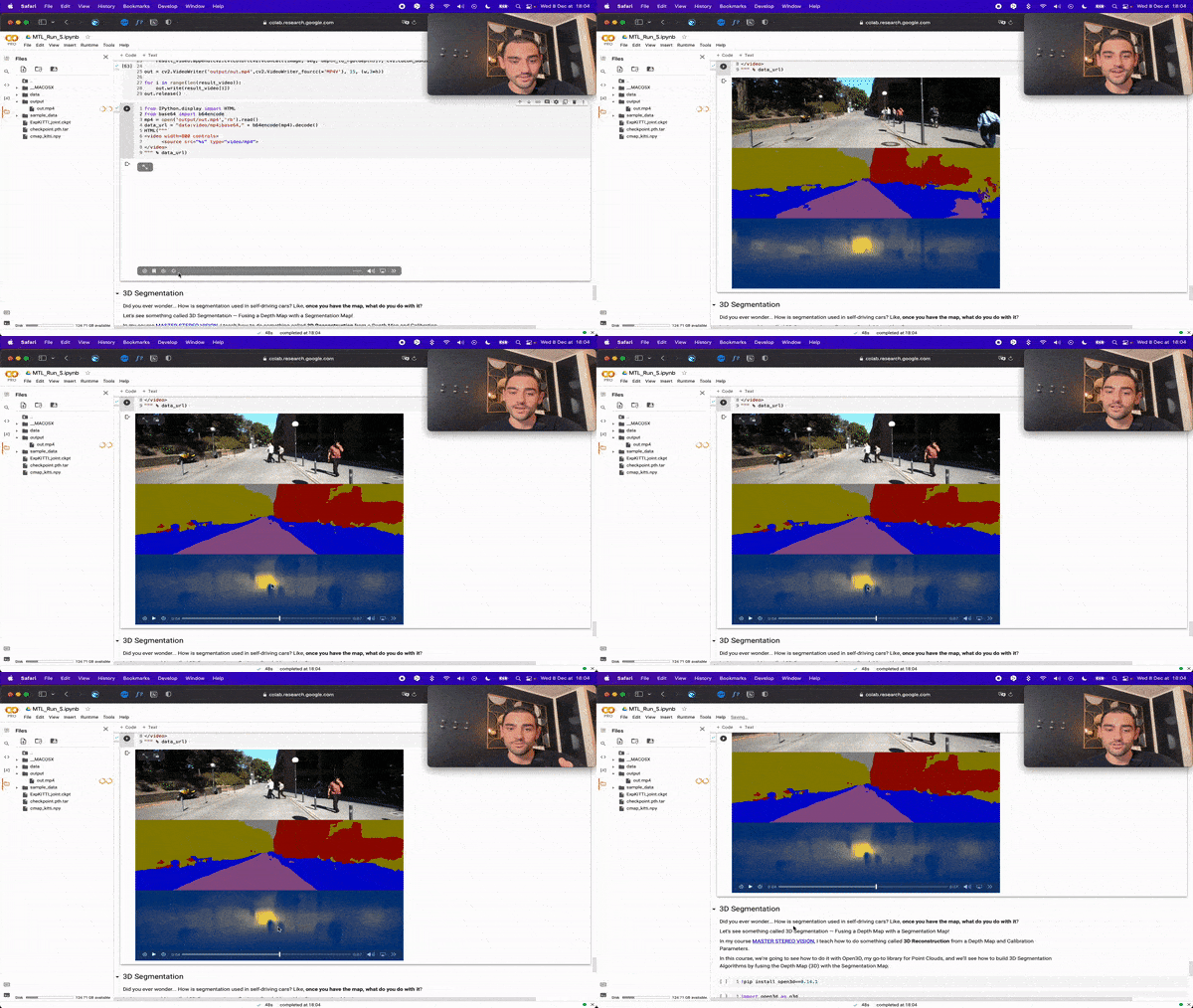
  • 3D Segmentation — My technique to fuse a Depth Map with a Segmentation Map and reconstruct a 3D Point Cloud already segmented. (Hint: You can also add other "heads" outputs to this point cloud, such as object detection boxes)
That last point in particular is very interesting: 3D SEGMENTATION.
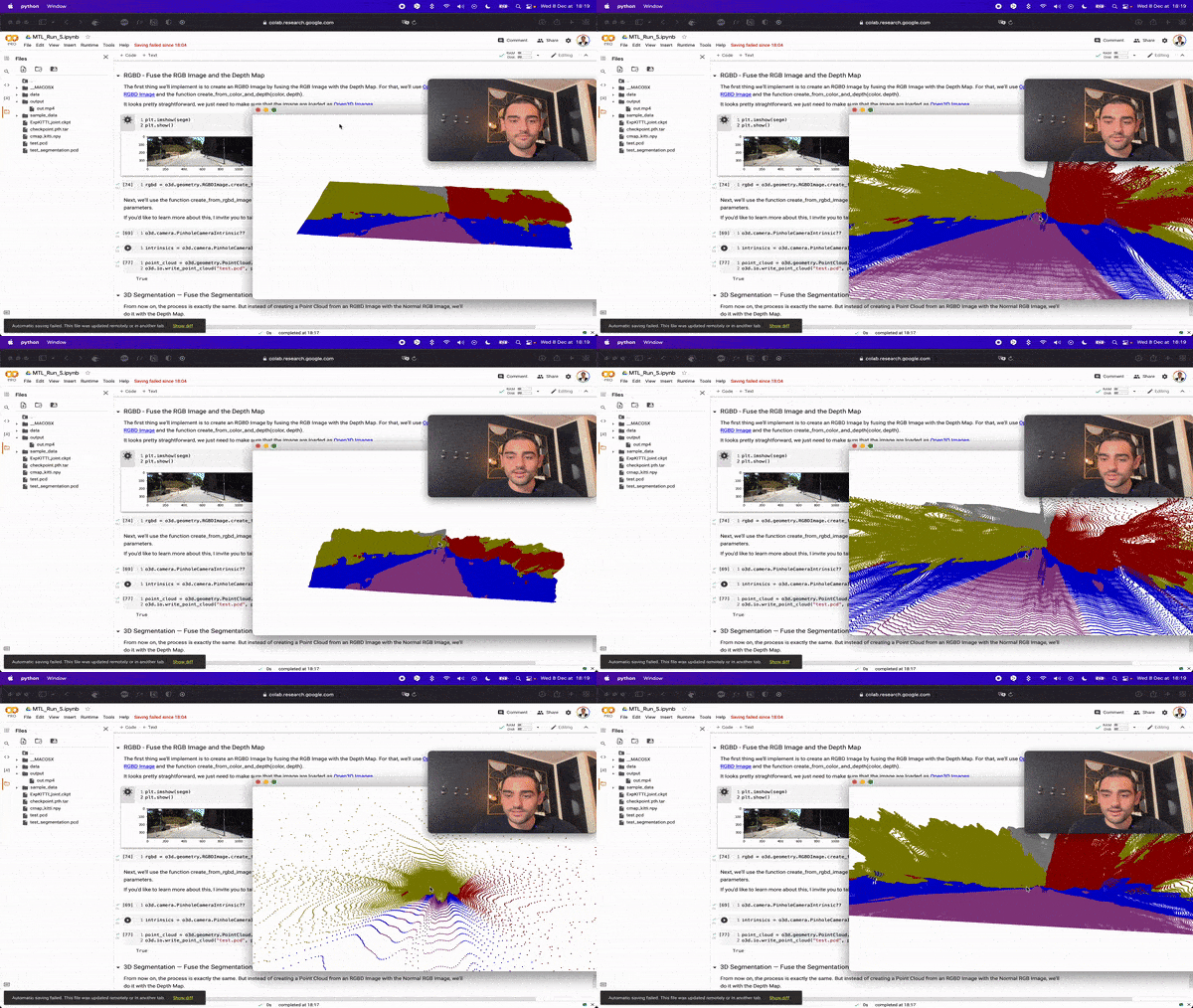
If we have a depth map and a segmentation map, and assuming we know our camera parameters, we can build a 3D Point Cloud that has already been segmented.
Here's what it looks like:


In module 2, we'll use a pretrained model and focus on building a model, then running it and analyzing the output. In Module 3, we'll learn how to train it.

Module 3 — Training Cutting-Edge Models with PyTorch

In the last module, we'll implement the training techniques used to come up with a state-of-the-art multi-task encoder/decoder network such as the one we used in Module 2.

You'll learn:

  • The Loss Function of a model doing Monocular Depth Estimation Neural Networks and Semantic Segmentation Neural Networks (plus what are the independent losses for single-task models)
  • How to train a HydraNet with or without Transfer Learning
  • A simple trick to to influence training to learn one task more than the other and finetune a model.
  • How to use multiple optimizers with PyTorch.
  • Home Robot Project — Train a HydraNet for Home-Robot Segmentation and Depth Estimation.

Is this course for you?

There might be several reasons not to go on with this course, either technical reasons, or mindset reasons. Here are a few reasons why you should not join the course:
❌ You have no idea what Deep Learning is, but just feel like the word HydraNet is cool
❌ You don't have basic Deep Learning skills, and have never worked with Convolutional Neural Networks before
❌ You can't code in Python
❌ You just want to watch videos and don't feel ready to code
(this is my most practical course ever)
❌ You're looking for a safe skill, that 100% of companies are looking for (this is a course for early adopters)
❌ You're already good with Multi-Task Learning and comfortable implementing research papers
❌ Finally, if you're looking for a very-well documented field, where you can just ask and get all the answers you want, this course isn't for you. Multi-Task Learning is a field so new that most people are just not there yet.

However, if:
✅You have some good Deep Learning skills and feel ready to go deeper in PyTorch (and Python).
✅ You know how to code in Python, but you don't know how to Pythonize your code
✅ You have already built Single-Task Learning projects, are are curious to learn how to go Hydra
✅ You want to learn everything I mentioned before, and feel ready to explore.

Then this course is totally going to help you push your skills to the Hydra World! Here are a few questions you might have:

Do I need to know PyTorch to take this course?

I don’t know about you, but learning PyTorch has always been a nightmare to me. Even running a cat vs dog classifier felt complicated.

And yet, when looking at PyTorch tutorials doing cat vs dog, I feel like I’m not making any progress.

It's like your doing okay on the intermediate skills, but you're left behind by the beginners skills.

Maybe you're interested in building the skills Deep Learning companies are looking for, but don't feel comfortable enough with your PyTorch skills.

When I started, I had this awkward feeling like everybody preferred Keras, but everybody was still insisting in learning PyTorch and hiring PyTorch practitioners.

👉🏼 In some of my courses, I ask you to have solid foundations with PyTorch. Not in this one.
Actually, it's quite the opposite. I'm expecting you to be ready to learn the 101 of PyTorch . A part of this course will be about PyTorch, about DataLoaders, Models, and Optimizers. After this course, you'll know how to use PyTorch for both single task and multi-task learning.

It's not about understanding one example, it's about also feeling capable to adapt to any future project that implements PyTorch.

How long is the course? What is it like?

Depending on your level, it can take you between 4 and 7 hours to complete the course.
The goal of the course is to help you learn hydranets by building 3 different projects. Depending on how far you want to take these projects, you can spend more time.

The course will be a hybrid of videos and text. You won't need any GPU, everything will be done on Colab.

How does this help me as a Deep Learning or Computer Vision Engineer?

"Deep Learning Engineer" and "Computer Vision Engineers" are both Job Titles that include Multi-Task Learning and will require it in the next few months/years.

When you own one of these 2 job titles, you need to be able to keep up with the research, adapt to a market that is constantly evolving, and build advanced, real-time algorithms, such as the multi-maps algorithms in this course.

You'll also need to know how to train a model, optimize it, and make sure it generalizes well.

This course will teach you how to use PyTorch, one of the most popular framework in Deep Learning, and how to build intermediate Python skills.

More: This course is made for the engineers who are ready to get out of the beginner++ zone, and experience building more intermediate skills.

As I said earlier, this course is for Early Adopters.

DLC

Hydra-Object Detection

A cutting-edge approach that will teach you how to add Object Detection Heads to pretrained models. This DLC features multiple approaches such as YOLOX, SSD, YOLOv8, and more...

  • How to build an object detection head on top of existing HydraNets

  • Object Detection Mini-Course & Analysis of HydraNets featuring Object Detection Heads

  • 3 cutting-edge implementations (notebooks, writeups, and models) submitted to the Think Autonomous HydraNet Challenge

Plus:

  • BONUS — DLC students get access to the Interview I did with HydraNet Researcher Vladimir Nekrasov (who built the HydraNet of this course)

Pick your HydraNet Journey

* For both, two time payment plans are available at no cost.

⭐️ Edgeneer's Land Price: 229€ or 329€

TWO-HEAD MONSTER

HydraNet Course

✅ LEARN HYDRANETS (299€)

-

-

-

299

THREE-HEAD MONSTER

Object Detection Edition

✅ LEARN HYDRANETS (299€)

✅ OBJECT DETECTION DLC (199€)

✅ HYDRANET RESEARCH MASTERCLASS (59€)

399€

Xose Ramon Fernandez Vidal, HydraNet Edgeneer

"This is a magnificent practical course"

Before joining, my biggest obstacle is the time required to complete this course. But I enrolled, and I have discovered a network architecture for multitasking that I did not know how to implement. I loved the quality of the material and the practical content, and I liked to learn about possible practical application fields of multitasking.

This is a magnificent practical course for discovering real areas for the application of multitasking architectures. The didactic quality of the course and its material were great.

Pick your HydraNet Journey

⭐️ Edgeneer's Land Price: 229€ or 329€

TWO-HEAD MONSTER

HydraNet Course

✅ HYDRANETS (299€)

299

THREE-HEAD MONSTER

Object Detection Edition

✅ HYDRANETS (299€)

✅ OBJECT DETECTION DLC (199€)

✅ HYDRANET RESEARCH MASTERCLASS (59€)

399€