BECOME A LIDAR ENGINEER, AND GET 3D PERCEPTION JOBS BY LEARNING FROM...

THE LIDAR PACK

The place to get started in LiDAR, build up 3D Skills, and go to the cutting-edge of 3D Deep Learning

Interested in becoming a LiDAR Engineer? Here are a few things to know...

You may have noticed how amazing LiDAR technology has become. From self-driving cars, to robots, drones, phones, 3D, and now spaceships and futuristic applications. But before I tell you about my 3 LiDAR courses that helped hundreds of engineer join autonomous tech via LiDAR, and before considering becoming a LiDAR Engineer, there are 3 core things you should know:

1

LiDARs aren't a niche market where you'll just disappear

Is LiDAR popular? Or is it just a fancy adventure nobody will care about?

When looking at Google Trends, I expected LiDAR to be a small topic for a few hobbyists...

The joke was on me!

Look at how it compares to these popular keywords such as Computer Vision, or Deep Learning:

It goes even further, LiDAR is in growth, and catching up with highly targeted keywords like "Robotics".

This is the first thing I want to share: LiDAR is going mainstream.
Just like Computer Vision is today.
But for now, almost nobody can use this technology, which means this is still a "rare' thing to be a LiDAR Engineer...

2

LiDARs are becoming incredibly advanced, and a go to system

LiDARs evolve so much right now that there is even an entire new field called FMCW, or 4D LiDARs. And you can be a precursor of that field, if you handle LiDAR well!

In fact, this exact LiDAR from Aeva I'm showing has been selected to go and map the Moon!

3

Are LiDAR Engineers the new gold?

If you learn how to work with LiDARs, you will be able to work on self-driving cars.

But LiDARs are used way outside of the self-driving car space. And in fact, in industries like IoT, topography, or robotics, you could even get an easier access, and earn the same if not more.

Because as I just shared, this is a rare skill that most engineers don't focus on.

As a LiDAR Engineer in 2018/2019, your only options were in the self-driving car field. That's fantastic, but that reduces the number of companies.

But today, you can be a LiDAR Engineer in the medical field.
You can be a LiDAR Engineer in smart cities and infrastructures.
In Robotics.
Or also, yes ADAS and self-driving cars.

All of these have the same advantage; there aren't many resources available, but the needs are increasing.
Basic supply and demand.

LiDAR Engineers might just be the new gold...

In my LiDAR Pack, I'm going to teach you the 8 LiDAR skills that I consider essential to be a LiDAR Engineer.

So here are these 8 skills

  1. Build a LiDAR Expertise — including understanding the optics, physics, types of LiDARs, and overall ecosystem

  2. Point Clouds Processing — including how to read and encode a file, use filters, ...

  3. 3D Machine Learning and how to process point clouds to find obstacles or the drivable area

  4. Sensor Fusion and how to fuse a LiDAR with other sensors such as cameras or RADARs

  5. Point Cloud Projection and 3D-2D Spaces

  6. Box to Box Fusion and how to fuse 3D Boxes from LiDARs with 2D Boxes from cameras

  7. 3D Deep Learning, including Voxel-Based and Point-Based Learning approaches for classification or segmentation

  8. 3D Object Detection using State-Of-The-Art Deep Learning architectures


Through my LiDAR Pack, you'll get to learn these 8 skills through 5 of my most popular courses.
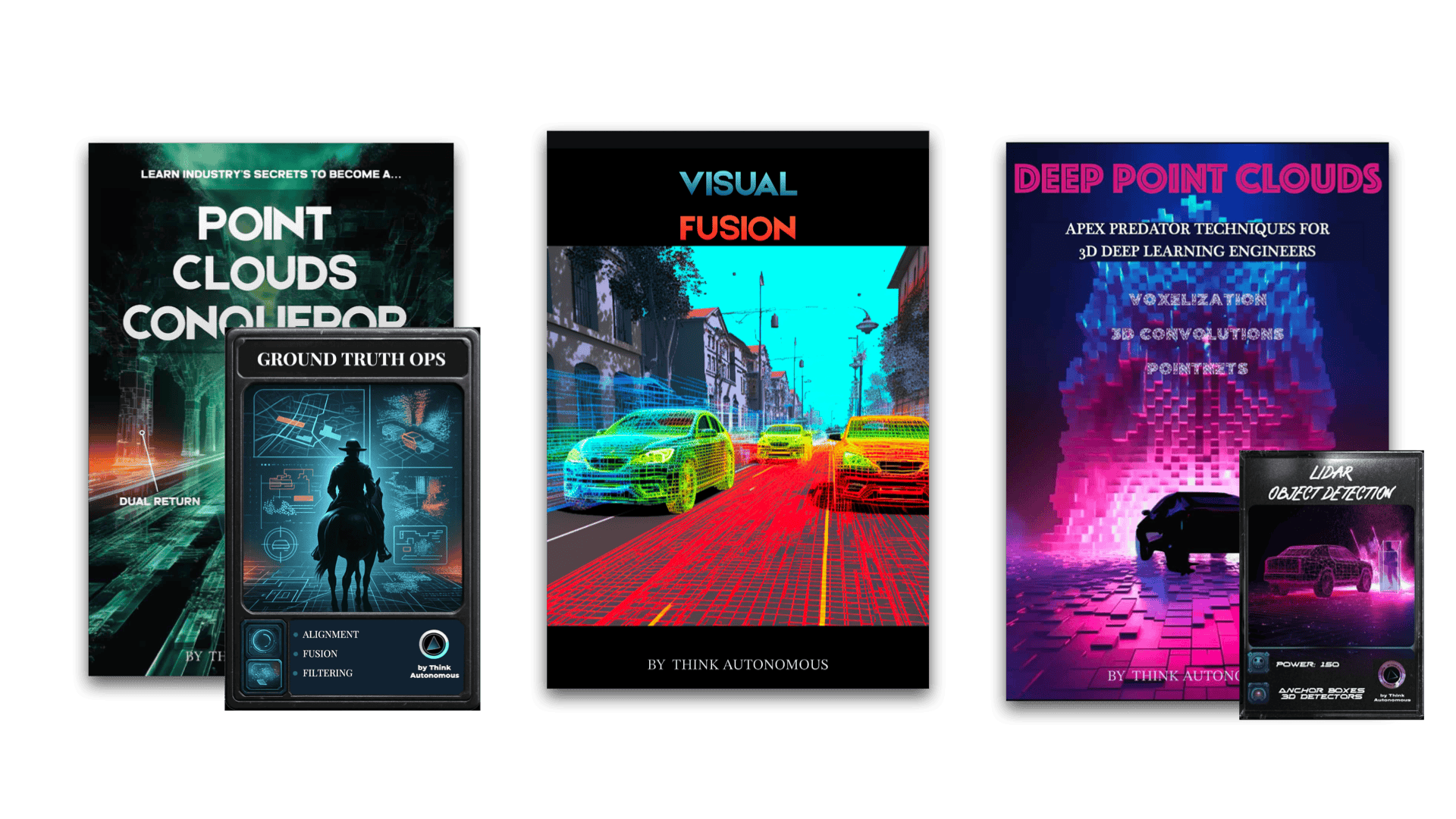
Ready to learn more?

Let's see the courses included one by one.

POINT CLOUDS CONQUEROR: Master the Industry Reserved Secrets to LiDARs & 3D Perception

Begin your Journey in LiDARs & 3D Perception on Point Clouds

In the course, you'll learn what's a LiDAR, how does it work, and you'll process real point clouds to find objects in 3D and do driveable area segmentation.

Here's a sample of what you'll learn

MODULE 1

Introduction to LiDARs

Learn the fundamentals of 3D sensing. What are the different types of point clouds? Are there different ways to interpret the data?

Techniques:
LiDAR sensing, 3D Perception, Point Cloud Files, Property Encoding, Point Cloud Processing Libraries, LiDAR Types, Solid-State, Flash, Mechanicals, FMCW, ToF, Ranging

MODULE 2

Point Cloud Processing & 3D Machine Learning

Computer Vision is about detecting obstacles in 2D. In this course, we'll do this in 3D using LiDAR sensors and Machine Learning techniques.

Techniques: Point Cloud Processing, Downsampling techniques, Segmentation, Unsupervised Learning techniques applied to 3D Data, Plane Fitting Algorithms, Clustering techniques, Optimization strategies, Bounding Box fitting in 3D, Filtering, 3D ROI, ...

MODULE 3

Advanced Point Clouds Processing

In the third module, you'll learn how to use advanced feature extraction, point cloud registration, and surface reconstruction techniques.

Techniques: ICP,  Surface Normals, Filtering, Feature Extraction, FPFH, Keypoint Estimation, Pose Estimation, Poisson Reconstruction, ...

Some testimonials from POINT CLOUDS CONQUEROR:

You're in good hands with this course, here are some reviews from other students:

Mayur Waghchoure, Autonomous Driving Software Engineer, Dorle Controls

Recently, I have completed a course on introduction to 3D Perception from Think Autonomous; I am extremely satisfied with the content and your delivery. I have started with a new course on 3D Deep Learning and now learning PyTorch.

Sujitha Kurup, Research Assistant at SVKM's Narsee Monjee Institute of Management Studies

I am a research scholar based in India, trying to work on 3D modeling of the indoor environment. I was running in circles regarding my point cloud until I came across your website to join the course on 3D Perception and since then it has been a really great learning experience.

Jay Reddi - Senior Specialist, Deloitte

I really enjoyed the course! Thank you for preparing clear and concise lectures and interesting coding assignments. I took this course to get a better understanding of lidar in general and learning about Open3d and pptk was very useful. 

Varsha Sathya, System Engineer - Autonomous and Connected Vehicles, Tata Consultancy Services

I was absolutely new to point cloud and was quite lost in the information available online. This course is such a good kick-starter for anyone who wants to start upskilling with 3D perception. Also quick support from Jeremy and the team from simple doubts to any other issues is commendable. This makes the course more unique as its not just a bunch of videos but also mentor level support from industry experts.

More!

Reshma K, PhD in 3D Object detection for autonomous vehicles

"The price was originally a blocking point for me, but it was really informative from a practical point of view."

"As a PhD student who works on data fusion and has not worked much on lidars before, the practical perspective given to point cloud processing in this course would definitely help get a head start on understanding and coding with point clouds.

I like that it is very hands on and the results are able to be visualized at every step. So, there is an instant gratification there, which gives you the motivation to go forward. Majorly, you get an insightful understanding. I like the part where you explain the functioning of inbuilt functions because in my field of work, it is important to understand the inside out and not just the end result.

I would definitely recommend this product to beginners like me because if you are working on lidar point cloud processing in a deadline based environment, be it industry or academia, and if you have never worked on lidars before, you definitely need a head start with the structure and understanding of point clouds, else you will be lost at sea if you delve without an anchor point. This course provides you the skeleton and you can build on from there."

Rahul Guptha, Point Clouds Conqueror

I'm halfway through the "POINT CLOUD CONQUEROR" course and I must say each module has been full of surprises and interesting.

"It's been a fantastic experience so far. I have chosen this course because it aligns perfectly with my career goals in Robotics. What I loved most about it was the Mind map summary in each module and hands-on approach.

Overall, I would highly recommend this course to students who are looking to gain deep insights into LiDAR and processing techniques.

Thank you once again for providing me with the opportunity to learn new things."

POINT CLOUDS CONQUEROR: GROUND TRUTH OPS

Point Clouds Conqueror has an ADVANCED 'post-course" module, called Ground Truth Ops. In this DLC, you are diving into the "ground truth" of how companies use LiDARs in the field.

Course 2 - LEARN VISUAL FUSION: Expert techniques for LiDAR Camera Fusion in Self-Driving Cars

An advanced course for engineers who want to master sensor fusion in 2D and 3D.

In the second course, we'll learn about Sensor Fusion between LiDARs and Cameras.

Here's what you'll learn:

MODULE 1 - Introduction to Sensor Fusion

Learn about LiDARs, Cameras, and about the Sensor Fusion algorithms we can use to fuse data from multiple sensors.

Concepts: Point Cloud Processing, 3D Visualization, Camera Calibration, Centralization, Abstraction, Competition, Early vs Late Fusion, ...

MODULE 2 - Point Pixel Fusion Deep Dive

Learn to project point clouds in 2D images and to fuse the data to build a 3D Object.


Concepts: Homogeneous Coordinates, Rigid Body Transformations, Agnostic Fusion, Outlier Detection, Object Detection, Point Pixel Fusion, ...

MODULE 3 - Box To Box Fusion

Learn to fuse outputs from 2D and 3D algorithms to build a robust and efficient Sensor Fusion system.


Concepts: IOU, Hungarian Matching, Deep Matching, Object Detection (2D, 3D), Corner Extraction, Box To Box Projections, Fusion Cost Metrics, 3D Bounding Boxes, ...

One of your projects...

In this project, you'll learn to fuse Point Clouds with Bounding Boxes and retrieve the depth information of the detected objects.

Visual Fusion Engineers:

Adrian Rosebrock | PyImageSearch

"Jeremy is an incredible teacher and the best person to to learn autonomous cars from"

"Last Week, Jeremy Cohen launched Visual Fusion for Autonomous Cars 101 [...]. I cannot even begin to express the number of positive reviews we've gotten from the course.

Jeremy is an incredible teacher and the best person to to learn autonomous cars from."

Course 3 -LEARN DEEP POINT CLOUDS: Introduction to 3D Deep Learning

Get to the leading edge of research and take your Deep Learning skills to the next level.

At this point, you'll know about Machine Learning in 3D, and Sensor Fusion... but what about classifying these objects? What about 3D Bounding Boxes? Enters 3D Deep Learning.


In DEEP POINT CLOUDS, you'll dive in the advanced Deep Learning architectures used to create models that can classify, segment, and detect objects from point clouds.

Here's what you'll learn:

MODULE 1

Introduction to 3D Deep Learning

Learn about the most popular types of 3D Data and what algorithms are used to process these data. Dive into 3D Convolutions, Graph Networks, and other 3D Applications.

Concepts: Multi-View Images, Voxels, 3D Convolutions, Meshes, Graph Convolutional Networks (GCN), Point Cloud Processing, ...

MODULE 2

3D PointNets

In the second module, we'll dive in the Point based architectures like PointNet and PointNet++, and code algorithms to classify point clouds with Neural Networks.


Concepts
: Network Invariances, Spatial Transformer Networks, Geometric Learning, Part vs Semantic Segmentation, Classification, Loss (Chamfer, NLL, ...), Shared MLP, Feature Pooling, PyTorch, Open3D, ...

MODULE 3

Voxelization & 3D Convolutional Neural Networks

In this part, you'll learn how to transform a point cloud into a voxel, and how to apply 3D CNNs to learn features from them.


Concepts: VoxelNet, Voxelization, 3D CNNs, RANDLANet, PIXOR, Fast and Furious, PointPillars, Open3D-ML ...

To make this experience truly unique and advanced, we also built an advanced program, called the LiDAR Object Detection DLC, in which you're learning how to detect objects using handcrafted 3D Object Detection architectures.

This is the cutting-edge. You're working on the research level, building your own models to detect objects in 3D.

The LiDAR Object Detection DLC 🔐

Push your 3D Deep Learning skills to the limit, and master powerful 3D Object Detection architectures

3D Deep Learning Testimonials:

"I've just started learning the materials in the 3D Deep Learning course... it's worth every penny!"


"At first, I wasn't sure where to start in terms of the underlying algorithms of developing a multi-sensor perception system and wasn't sure that an online course would answer all my questions, but Jeremy really knows his stuff!

The video tutorials are well explained and the assignments or challenges are well designed in making sure that I understand every bits of the algorithms.

I'm currently applying these new knowledge to build a multi-sensor perception system for next-generation off-road, heavy vehicles Thank you for the unlimited lifetime course!"

De Jong Yeong, Postgraduate Researcher at Munster Technological University

"I think this is one of the best courses from Think Autonomous"


The differences between the 3D representations are very well illustrated. Especially the Voxel part is truely great pictured.

As a busy engineer I very much appreciate the workshops that just work. I typically spend many hours playing with them to get behind the details. Thanks for this course!"

Ivo Germann, Development R&D Engineer for Vision Systems

Xavier Rigoulet | Computer Vision & Sensor Fusion Engineer

"Your LiDAR package was invaluable in helping me get a position as a computer vision engineer"

Thank you, Jérémy! Your LiDAR package was invaluable in helping me get a position as a computer vision engineer.

The knowledge gained from the courses and the very practical and relevant projects have allowed me to stand out and land this job opportunity- without them, there is no way that would have been possible at all...thank you so much for creating such great content on thinkautonomous.ai

☄️

What's unique about the LiDAR Pack?

The LiDAR Pack is unique because it's a complete experience from 0 to mastery in LiDARs.

While other courses may tackle one concept at a time and never really dive in the details, these courses will lead you from opening your first point cloud file to voxelizing 3D environments and implementing state-of-the-art 3D Object Detection Networks.

Having that complete journey is important, because it means the skills covered will be enough for you to become a LiDAR Engineer. This bundle is a complete LiDAR Engineer Map.

Who is a right/wrong fit?

Because the LiDAR Pack is a journey from beginner, the requirement list is pretty low.

However, you should still:

  • Be able to code in Python

  • Understand fundamental Deep Learning and Machine Learning concepts; having trained neural networks, etc...


❌ If you've never trained or ran any Neural Network on any task, you may find the content, especially the third and fourth course, a bit too advanced. So proceed with caution.

Then there's the spirit:
✅ LiDAR Engineers like adventure, they like the idea that what they're doing is a bit "edgy", and that it's not 100% covered by StackOverflow, that some questions don't even have an answer yet, and most of all you should understand that by joining this field, you'll be a contributor and active player rather than one more learner.

Here's everything you get when you invest in the LiDAR Pack today

✔ POINT CLOUDS CONQUEROR [299€ value]

✔ GROUND TRUTH OPS DLC [199€ value]

✔ LEARN VISUAL FUSION [249€ value]

✔ DEEP POINT CLOUDS [495€ value]

✔ LIDAR OBJECT DETECTION DLC [199€ value]

TOTAL VALUE: 1,441€

>>> 997€ or 3*349€